




FREE · 180 MIN TOTALPRO · UNLIMITED
Your Jellyfin, Emby and Plex library
Browse posters, shows and episodes, then play directly or choose a quality converted on the server.
Media Servers guidePlay MKV, MP4 and HEVC videos, choose audio and subtitles, and cast local files to supported TVs.
Local and network-share playback are free with no time limit. Includes 60 casting minutes in total, once; 180 media-server minutes in total, once; and 10 offline downloads. Pro removes these limits. See current pricing in the Microsoft Store.
Windows is the only platform AIX Player is released on today. Mac, iPhone, iPad and Android versions are in development, with no release date yet — the same player, the same library, the same one-tap casting.
The gap between “it opened” and “that looked incredible” is made of small things — a file that refuses, a subtitle a half-second late, a laptop roaring through a 4K scene. AIX Player brings those controls together and can put the result on a supported television.
Google Cast, Fire TV, Roku, Apple TV, LG webOS, Samsung Tizen and DLNA TVs — AIX Player finds them on your network by itself.
If your TV can't play a file, it converts on the fly using your graphics chip — and your subtitles render right on the TV screen.
No separate codec pack to install. Support for most video file types and codecs is built into the app, including MKV, MP4, HEVC and AV1.
Subtitle a half-second late? Nudge it. Dialogue too quiet under the music? Boost it. Scene too dark to follow? Lift it. All from inside the player.
Supported hardware decoding can reduce processor load during 4K playback. The result depends on the file, graphics hardware, driver and power settings.
HDR and 10-bit playback on your PC can preserve smoother gradients. Playback performance depends on the file, graphics support, storage and display.
On a Snapdragon machine most apps run through a translation layer, and video suffers worst. AIX Player is built for that processor directly — so it runs like it should.
Not on launch, not before a film, not tucked into your library. Playing supported files on your PC is free and unlimited.
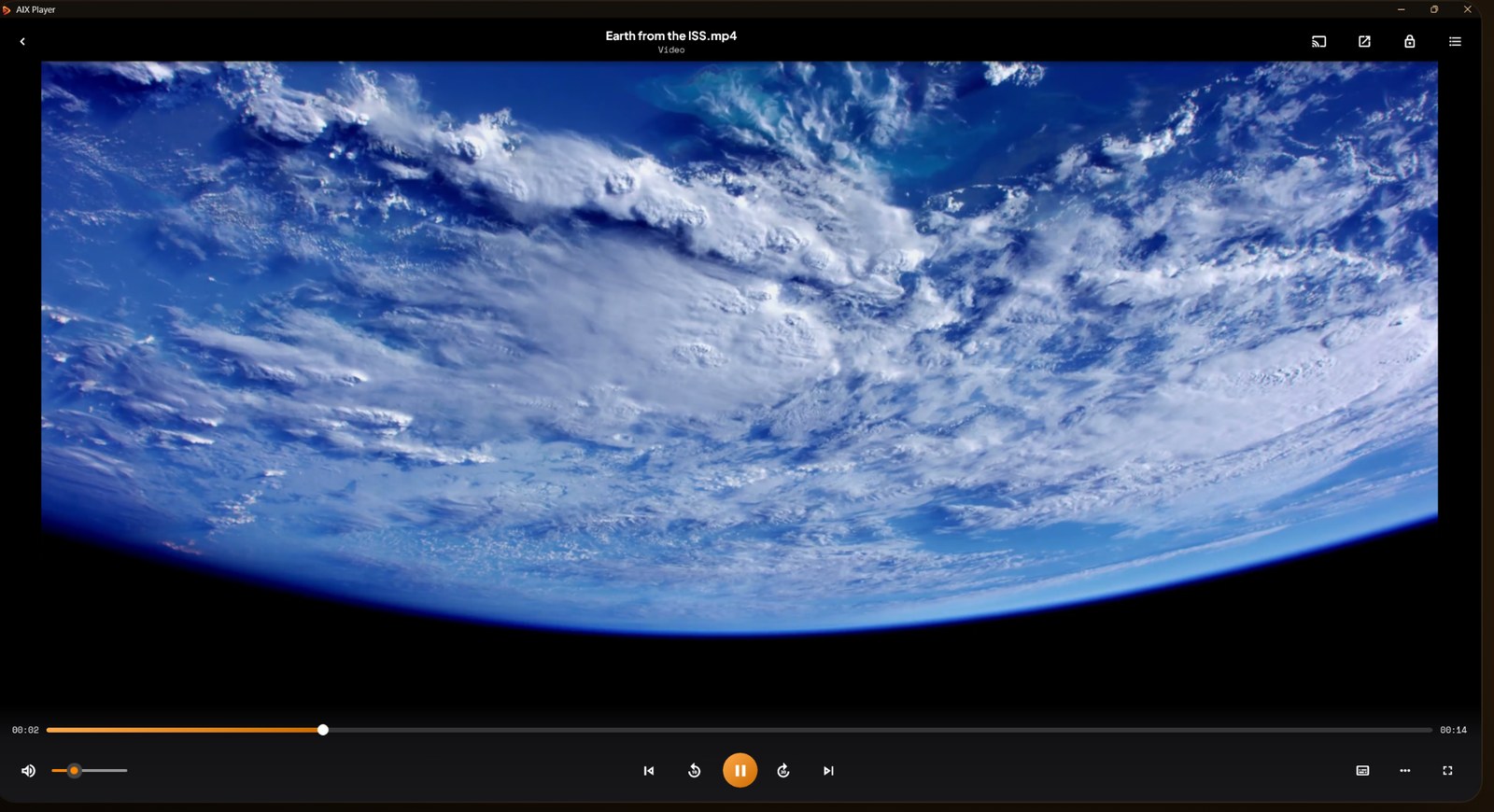
The controls a good player should have, all built in and all a click away — no menus to dig through and nothing extra to install.
AIX Player supports 83 video file types with broad codec support built in. No separate codec pack or add-on is required for supported files.
True 4K HDR with over a billion shades of color. HDR10 is tone-mapped to your display, so bright skies and dark corners keep their detail instead of washing out.
AIX Player uses supported graphics acceleration for decoding and tone mapping, with a processor fallback when the format or hardware requires it. Performance depends on the file, graphics driver, storage and display.
A subtitle running late, an audio track in the wrong language, a scene too dark to see — fix it all without ever leaving the video.
Most Windows apps were written for Intel chips, so on a Snapdragon machine they run through a translation layer. It works, but every instruction takes a detour — and video is the worst case for it, because a film is thousands of frames that each have to be decoded in time.
AIX Player ships a native build for each: x64 for Intel and AMD machines, and a true Arm64 build for Snapdragon. Decoding can use supported video hardware. When casting on Qualcomm, only H.264 encoding is hardware-assisted; other conversion stages use the processor. Performance and battery use depend on the file and system.
One tap sends a supported video to the big screen, up to 4K HDR where the source, PC, network and TV support it — with selected subtitles rendered in. AIX Player sends the video stream instead of mirroring the entire desktop.
Your TVs appear on their own, grouped by what they can actually do — no setup, no hunting through menus.
When several devices could take the film, AIX Player marks the one it ranks highest for that television.
Play, pause, seek, change volume, switch subtitles or disconnect — all without getting off the sofa.
Pick a device for its step-by-step guide. New walkthroughs are added to the Help Center as they are written.
The free app includes 60 casting minutes in total—once, not per session. Pro makes casting unlimited. See current pricing in the Microsoft Store.
Play on your PC from local folders, an external drive, a pasted link, your media server or a network share.
Eight areas, every feature. Pick one to see what is inside.
AIX Player decodes HEVC/H.265, AV1, H.264 and VP9 inside the app, and runs natively on Intel, AMD and Snapdragon (Arm64) Windows machines. Decoding uses supported graphics acceleration where available, with a processor fallback.
It casts to Chromecast, Google TV, Android TV, Fire TV, Roku, Apple TV, LG webOS, Samsung Tizen, Sony Bravia, NVIDIA Shield and DLNA televisions. Supported subtitle formats are rendered onto the picture before it leaves the PC, so the television does not need to read the subtitle file itself — external files included.
Your local library, media servers and network shares, ready to browse and play on your PC.
The controls you reach for while a film is running.
4K, HDR and 10-bit are free for everyone; the studio controls are the Pro part.
Every soundtrack the file carries, and the controls to make it sit right in your room.
Loaded, restyled, retimed — and they still arrive when the film goes to the television.
Seven television families, found for you, with the subtitles already on the picture.
Wherever the file already lives — nothing is copied, moved or renamed to get at it.
The app bends to how you work, and every setting can be put back.
Most trouble with video software starts with where it came from — a download site, a bundled extra, something asking for an account it does not need. None of that applies here.
The things people ask most often, before and after installing.
Playback of supported files on your PC is free and unlimited, including 4K, HDR and 10-bit, with no ads or trial. Network-share browsing and playback are also free, with no time limit. Media-server playback includes 180 minutes in total — once, not per session; Pro removes this limit. Casting includes 60 minutes in total — once, not per session; Pro removes the casting limit for supported TVs.
Yes. Get AIX from its official Microsoft Store listing. No download-site installer, no bundled extras, nothing to untick during setup.
Not to play local files. To browse and play from Jellyfin, Emby or Plex, sign in to your server.
For two things you have probably already hit. Files that simply will not open — an MKV, a film copied from a disc — and getting them onto the television without converting anything or losing the subtitles on the way. If neither has ever bothered you, you may genuinely not need this.
Windows 11, or Windows 10 version 2004 (build 19041) or later, 64-bit. Native builds are available for Intel/AMD x64 and Snapdragon Arm64. Hardware acceleration varies by format, graphics support and driver; unsupported paths use the processor.
Supported files on your PC or an attached drive can play offline. Casting needs your PC and TV on the same home network. Network shares and media servers need a connection to the selected computer or server; Plex sign-in also contacts Plex. A pasted stream URL needs a live connection.
Hardware acceleration can reduce processor load. AIX Player uses it where the format and graphics hardware support it, then falls back to the processor when required. The impact varies by file and system.
17 languages. The interface follows whichever language Windows is already set to. Subtitle and audio tracks are separate — those come from the file you are watching, and you can switch freely.
Usually yes, if it downloads in order. A partly complete file will play up to the point it has reached. Torrents that download in pieces often will not, because the beginning may not be there yet — wait for it to finish and try again.
Nine times out of ten it is incomplete, not corrupt. An interrupted download or a copy that failed part-way leaves a file that looks whole but is not. AIX Player will play as much as exists, which is a quick way to tell: if it stops at the same point every time, that is where the file ends.
Yes, straight away. That includes 4K HDR and 10-bit MKV, with every audio and subtitle track inside available to switch between. MP4, AVI, MOV, TS, M2TS, WebM, FLV, WMV and 76 more work the same way.
No. AIX Player includes HEVC and AV1 decoders, so no separate Windows codec pack is required. Supported graphics acceleration can reduce processor load for 4K playback, with a processor fallback where required.
Your PC can read the sound half but not the picture half. The video is usually HEVC (H.265) or AV1, and Windows has no decoder for those on many machines — so you get audio and a black screen, or an error about the file not playing. AIX Player brings its own, so the picture and the sound arrive together.
It has a cinema-style surround soundtrack your PC cannot read. Films copied from discs usually keep the full surround mix from the cinema, and most computers have no way to play it — so you get picture and silence. AIX Player plays it, and keeps all the surround channels rather than squashing them into plain stereo. Nothing to install.
Try it from another folder first. Practically every kind of video file is supported, so this is rare — a file that plays nowhere is usually damaged or only partly downloaded. Genuinely stuck? Send us the file details and we will look into it.
It will play here. AV1 is a newer kind of video file, and only recent computers can handle it on their own. AIX Player brings what it needs, and on newer machines it lets the graphics card take over so playback stays light.
Yes. TS, M2TS and MTS open directly, with chapter marks and the full surround soundtrack intact. These files usually pair an advanced video track with a studio surround mix — both are handled.
It is your graphics software, not the file. Your graphics card is stumbling on that one type of video. AIX Player quietly switches to a different way of playing it so the colours come back — and updating your graphics drivers fixes the root cause.
Modern Windows dropped what those older files need. AVI and the video inside it date from the 1990s, and Windows no longer includes the pieces to open several of them. AIX Player carries them inside the app, so a file from 2004 opens just as easily as a 4K one — and nothing is changed on your PC.
It will open here, with nothing from Apple installed. MOV is what iPhones and most cameras record in, and Windows has always been awkward with it. Plenty of guides still tell you to install QuickTime — you should not, it has been discontinued for years. AIX Player reads MOV directly, including HDR and slow-motion recordings from recent iPhones.
Media-server videos play on your PC in 3.0.6; casting them to a TV is not supported in this version. You can still cast supported local files.
Yes. Nothing to convert first and no renaming .mkv to .mp4 to trick the TV — pick the file, pick your TV, press cast. If your TV genuinely cannot handle a file, AIX Player converts it while it plays, so the film still starts straight away.
Read the full guideBecause they never leave your PC. Most casting sends the television the video file alone. AIX Player draws the subtitles into the picture before it travels, so what arrives already has them — external .srt files included, in the size and style you chose.
Nearly always one of these, in order of likelihood:
Your network may be the bottleneck. Test with a wired PC or move closer to the router. Very large 4K files ask more of a weak network, and AIX Player converts unsupported parts while streaming when the TV requires it.
It is almost always the network. Roku sets and sticks appear on their own, so check that your PC and TV are on the same Wi-Fi — guest and split-band networks keep them apart — and that the Roku is awake. Roku is also the one device that needs a piece added to it: our free AIX Casting Receiver channel, added once from your Roku account with the code PG26GTJ. AIX Player hands you the link if it is missing.
Your TV could not play the soundtrack. It is usually the cinema surround mix that comes with films copied from discs, and most televisions cannot handle it. AIX Player converts it as it goes; if the film has more than one soundtrack, switching to a plain stereo one may also resolve it.
Yes, including supported files your TV cannot read directly. Televisions understand a limited set of video types. AIX Player checks what your TV can take and converts an unsupported part on the fly while the video plays. Your original file is never touched and nothing is saved to disk.
Only the parts the TV cannot play are converted. Often that is just the soundtrack, leaving the picture untouched. Video conversion can use supported Intel, AMD and NVIDIA graphics hardware; on Qualcomm, only H.264 encoding is hardware-assisted. Other stages use the processor, and output quality depends on the source and TV.
Because conversion happens as the video plays. AIX Player processes it frame by frame while streaming instead of preparing a separate converted copy first. Supported Intel, AMD and NVIDIA graphics hardware can accelerate conversion; on Qualcomm, only H.264 encoding is hardware-assisted. Start time depends on the file, TV and network.
You probably do not need one. If your television is a Samsung, LG or Sony smart TV, AIX Player connects straight to it using what is already inside the set. The same is true of Fire TV, Roku, Apple TV and Android TV boxes you may already own — and for older televisions there is usually a route in as well. Nothing to buy and nothing to plug in.
The file may be using processor decoding, slow storage or an unsupported hardware path. AIX Player uses supported graphics acceleration where available and falls back to the processor when required. Performance depends on the file, graphics driver, storage and display.
The film holds more brightness than your screen can show. HDR films are made for very bright displays, so on an ordinary monitor the extremes get cut off and everything looks flat. AIX Player reshapes the picture to fit your screen, so bright areas and shadows both keep their detail. You can fine-tune brightness and contrast too.
Switch the audio track. Films often carry several and the first is not always the right one — open the audio menu and pick another. Also worth checking Windows is playing to the device you expect: headphones, TV or speakers.
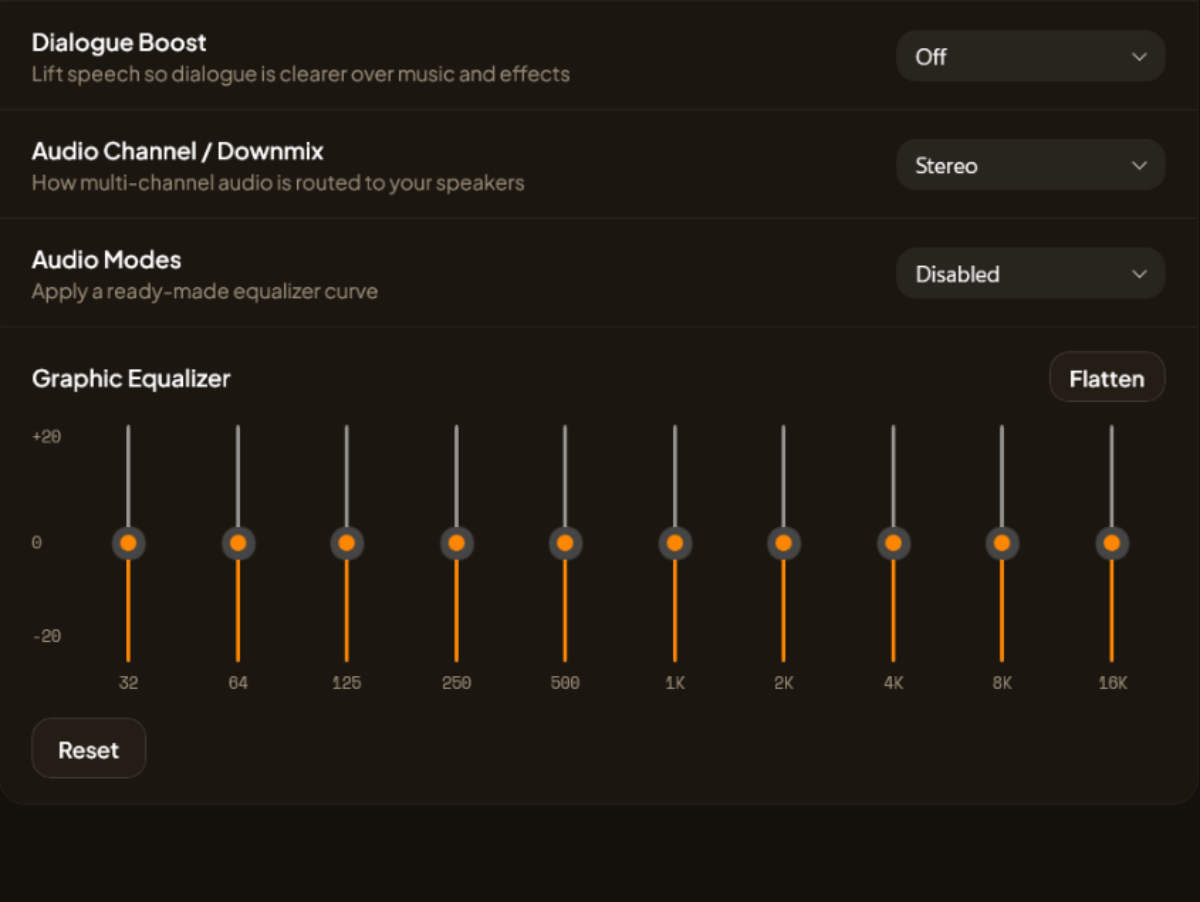
Yes — three controls help. The 10-band equaliser is free for everyone. Dialogue boost, which lifts speech over music and effects, and loudness levelling, which evens out the loud scenes for late-night viewing, are part of AIX Player Pro.
Nudge the audio delay. Shift the sound earlier or later while the film keeps playing, until lips and words agree. The offset stays with that file, so it is a one-time fix. Subtitles have their own separate timing control.
It is being shown at the wrong shape. Older recordings and phone clips sometimes carry the wrong information about how wide they should be. Change the shape setting to fit the frame properly, or zoom in to fill the screen. Clips filmed sideways can be rotated too.
Yes. Surround soundtracks keep all their channels rather than being squashed into plain stereo, so a film sounds the way it did in the cinema. It matters for casting too — many televisions cannot play these soundtracks, so AIX Player quietly converts them on the way.
Check the playback speed first. It stays wherever you last left it, so one tap returns it to normal. If that is not it, footage shot on a phone or camera at a very high number of frames per second can look odd on a screen running at a different rate.
The black bars are part of the picture itself. Some copies have them permanently built in, so going full screen just makes the bars bigger too. Zoom in to fill the screen properly, and AIX Player remembers that setting for the file.
Usually the drive it is stored on. A slow external drive or a failing disk cannot feed the film fast enough, even when the rest of your PC is coping easily. Copy the file onto your PC to test — if it plays smoothly there, the drive was the problem.
Yes, with ten bands and ready-made presets. Start from a curve made for films, music or voice, or set it by hand. The trick most people miss is to cut what is in the way rather than boost what is not — easing off the deepest bands does more for clarity than raising anything. Whatever you set is remembered for that file.
Yes. Capturing from the player saves an image of the current video frame. The saved dimensions and detail depend on the source and capture path.
One key, or one tap in the subtitle menu. Subtitles toggle without pausing the film, and the track you pick is remembered for that file so you do not set it again next time.
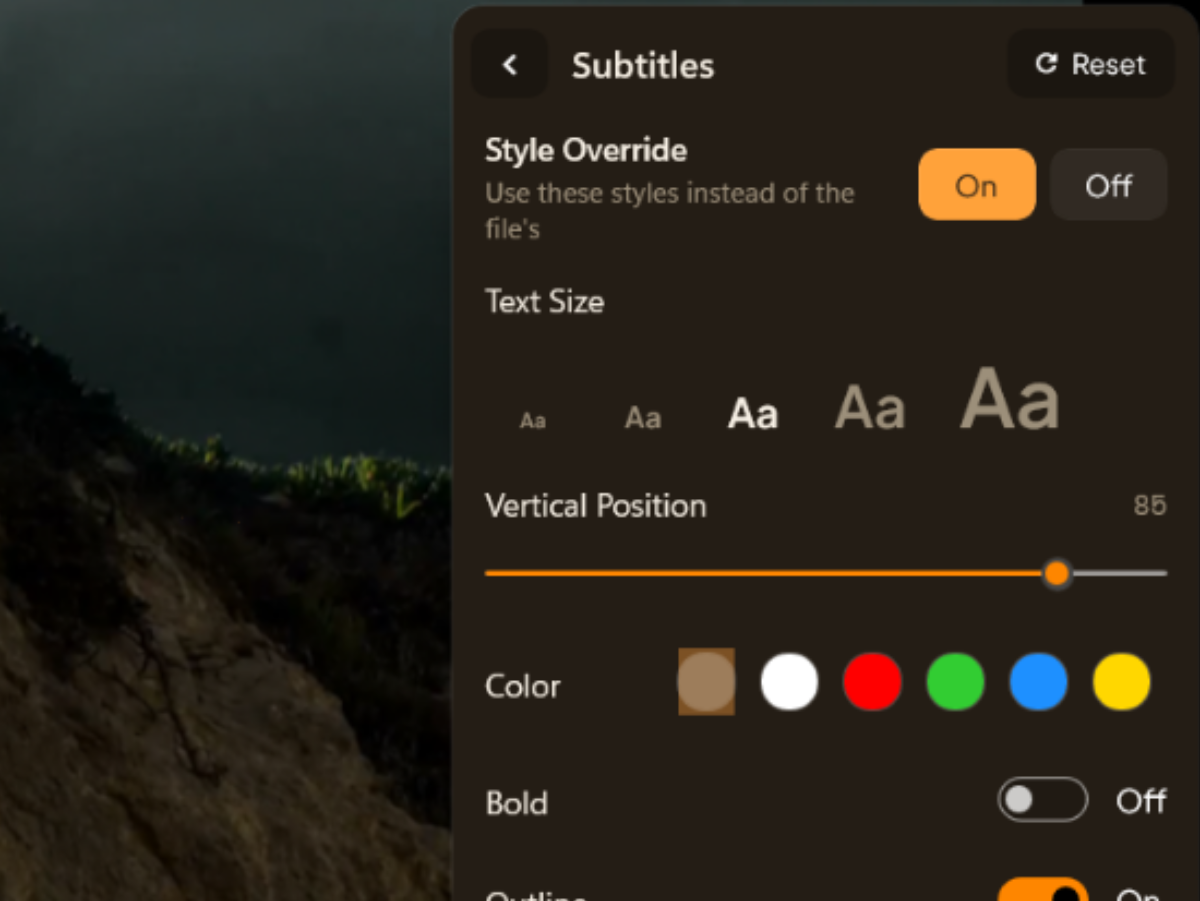
Yes — size, colour, outline and a backing box. Set them large enough for how far you sit from the screen. If you cast to a television afterwards, that styling travels with the picture, so size for the room rather than the desk.
A film often includes several, and the first is not always yours. Open the subtitle list and pick the right one. If one option only shows a handful of lines, that is the kind meant just for foreign dialogue — working as intended, not broken.
Yes, vertically. Useful when lines sit over on-screen text or fall into the black bar at the bottom. If subtitles ever seem to vanish entirely, position pushed too far is a common cause — resetting the styling brings them back.
From any subtitle site, then load the file directly. You do not need to rename it to match the video. Open the subtitle menu, point AIX Player at the file wherever it saved, and it loads immediately. SRT, ASS, VTT and disc-style image subtitles all work.
Not into the file, but they are burned in when casting. Your original file is never modified. When you cast, subtitles are rendered onto the picture before it leaves the PC — which is exactly why they reach televisions that cannot read subtitle files at all.
Load the file from the subtitle menu. No need to rename anything to match the video. Once it is on, you can restyle the text size, colour, outline and background box to suit the room you are watching in.
Yes. Shift them earlier or later while the film keeps playing, until the words land with the lips. The offset sticks for that file, so you only do it once. Audio can be nudged the same way if the sound is what drifts.
The subtitle file was saved for a different alphabet. That is why accented letters and non-English characters turn into boxes and question marks. AIX Player understands the usual ones, so files that looked broken elsewhere normally read correctly here — and another subtitle file for the same film will almost always work.
Yes — every file, individually. Close one mid-film, open it a week later and it picks up where you left off. Your library shows how far through each one you are, and you can drop named bookmarks on moments worth returning to.
Yes. Picture-in-picture floats the video in a corner over whatever else you are doing, and a mini player keeps it going while you browse the rest of your library. Playback speed goes to 2× for long material.
Yes, directly. External drives, USB sticks, memory cards and phones plugged in over USB all open in place, with nothing to copy to the PC first — and you can cast straight from them too. A very slow or old drive can make big 4K films stutter, and copying that one file onto your PC solves it.
Right-click a video, Open with, Choose another app. Pick AIX Player and tick Always use this app. From then on every video of that type opens in it. Repeat once for each file type you keep — or set them all in Windows Settings under Default apps.
Yes — open the folder and play through it. Everything in the folder queues up in order, and you can shuffle or repeat the run. For a fixed running order you want to keep, build a playlist instead and it stays saved.
Both. Repeat plays a file or a whole playlist over again, and A–B repeat loops just the section between two points you set — useful for practising a passage or studying a technique without scrubbing back each time.
Yes. Sign in, browse posters, shows and episodes, and play directly from all three on your PC. Original quality is the default, and you can choose a server-converted quality when the source or connection needs it.
Yes. Browse shared folders on your Windows network or a NAS (SMB) and play from them on your PC. AIX Player finds file servers on your network, and you can also connect by address.
The free app includes 180 minutes of media-server playback in total — once, not per session. Pro removes this limit for Jellyfin, Emby and Plex.
Point AIX Player at the folders they live in. It builds a library with thumbnails, durations and how far through each file you are, shown as a poster grid or a detailed list. Nothing is moved or renamed on disk — your folders stay exactly as they are.
Yes — grid or list, whichever you prefer. Every file gets a thumbnail, its length and a progress bar for what you have already watched. Switch to a list when you want file sizes and formats visible instead.
Search across the whole library, then sort. Sort by name, size, date added or file type, ascending or descending. Past a few hundred files this is far faster than opening folders one at a time.
Yes, and act on all of them together. Multi-select lets you favourite a batch, add them to a playlist or remove them in one action rather than repeating yourself for each file.
Yes — folders preview in place. Peek inside to see what is there, then drill into subfolders without losing your place. Useful when a drive has dozens of similarly named directories.
On its details page, all together. Quality, video type, length and file size on one screen — the quickest way to check whether a file really is the 4K version you thought you downloaded.
Removing is there; renaming happens in Windows. You can remove files from the library or from disk, and multi-select makes clearing out a folder quick. Renaming stays with File Explorer, so the player never changes your filenames behind your back.
Yes, with a version built for those machines. AIX Player has a native Arm64 build, so the app itself does not need a translation layer. Playback performance and battery use still depend on the file, hardware, driver, storage and display.
Sign in to the Store with the same account. Your purchase travels with the account, not the machine — install AIX Player and it is restored. If it does not appear, get in touch and we will sort it out.
They are in the works. Windows is the only released version today. The others are in development and we have not set a date for them — they will use the same playback engine and the same casting.
Install in seconds and open your first file. Windows only for now; Mac, iPhone, iPad and Android are in development.
