
Cast video from PC to a DLNA-enabled Smart TV
DLNA is the oldest standard in the house and still the most widely fitted. If a television is a few years old and connected, this is usually how AIX Player reaches it.
Supported videos from your PC can be cast to your DLNA television or receiver, up to 4K HDR where the source, PC, network and TV support it, with selected subtitles rendered on screen. AIX Player converts unsupported parts while streaming when needed.
Which files can I cast?
DLNA televisions read the shortest list of any device here, which is precisely why casting to them usually fails elsewhere. AIX Player decodes on the PC first, so MKV, MP4, MOV, AVI, WMV, TS, M2TS and WebM all become playable.
How does it connect to your DLNA TV?
AIX Player offers the video to the television over DLNA and lets it play the file directly. It is less clever than the newer protocols, which means it is fussier about formats — and that is exactly where on-the-fly conversion earns its place.
How do I cast it? Three steps
In AIX Player 3.0.6, Jellyfin, Emby and Plex videos play on your PC; casting media-server videos is not supported. Network shares (SMB / NAS) can be browsed and played on your PC for free, with no time limit. These casting steps are for supported local files. Read about media servers.
-
Open the video and set it up how you want it
Pick the audio track, choose the subtitles and style them for a room rather than a laptop. Everything you set now travels with the picture.
-
Press cast and choose your DLNA TV
AIX Player scans the network and lists what it finds by name. When more than one device could take the film, it marks the one it ranks highest for that television.
-
Sit down — your PC is the remote
Play, pause, seek, change volume, switch subtitle or audio track and disconnect, all from the AIX Player window. Nothing is mirrored, so you can carry on using the PC.
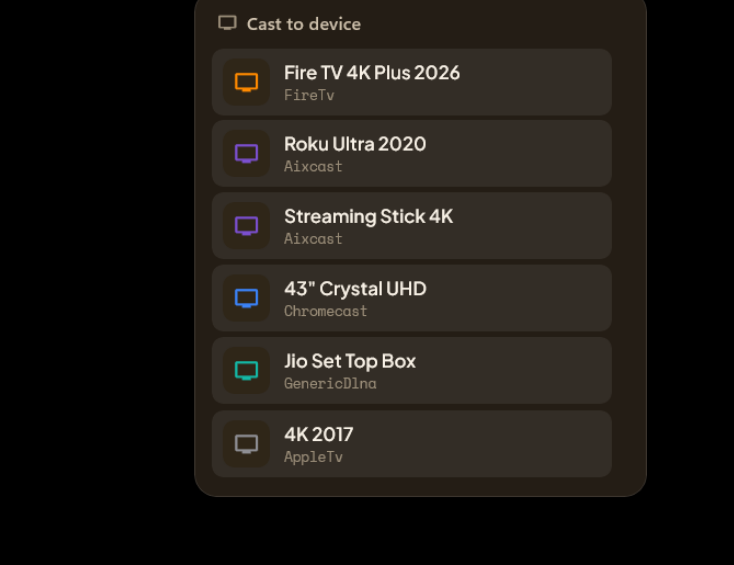
Devices appear on their own — nothing to pair by hand, nothing to type in.
Will my subtitles show on the TV?
DLNA has no concept of a subtitle file kept on your computer, and older sets often cannot render subtitles at all, even ones inside the video.
AIX Player renders supported subtitles into the picture before it travels. The television then receives them as part of the image instead of as a separate subtitle file.
What if my TV refuses the file?
DLNA televisions and receivers vary widely in what they accept, so AIX Player checks the device and converts unsupported parts while the video streams. Supported Intel, AMD and NVIDIA graphics hardware can accelerate video conversion; on Qualcomm, only H.264 encoding is hardware-assisted, and other stages use the processor.
DLNA casting questions
My TV has no Chromecast. Can I still cast to it?
Very likely, over DLNA. DLNA is fitted to most televisions from the last decade and to many AV receivers. If a set is connected to your network, this is usually how AIX Player reaches it.
Why does DLNA need conversion more often?
It reads a shorter list of formats. AIX Player checks what the television can handle first, then converts only the part that needs changing as the film streams — so playback still starts straight away.
Can I cast to an AV receiver instead of the TV?
Yes, if it supports DLNA. The receiver takes the film and passes it to whatever screen it is wired to, which is useful when the television itself is the older part of the setup.
Will subtitles work over DLNA?
Yes. Because they are drawn into the picture before it leaves your PC, they arrive even on sets that cannot render subtitle files themselves.
Casting to something else?
The same files, the same three steps and the same subtitles reach every TV family AIX Player supports — each paired through its own protocol rather than a generic fallback.
Put tonight’s film on a DLNA TV.
Install AIX Player, open a video, press cast. That’s the whole setup.
GET IT FROM Microsoft Store